

The Garage Light That Saved My Neighbor $340 a Year (And Scared Off Two Burglars)
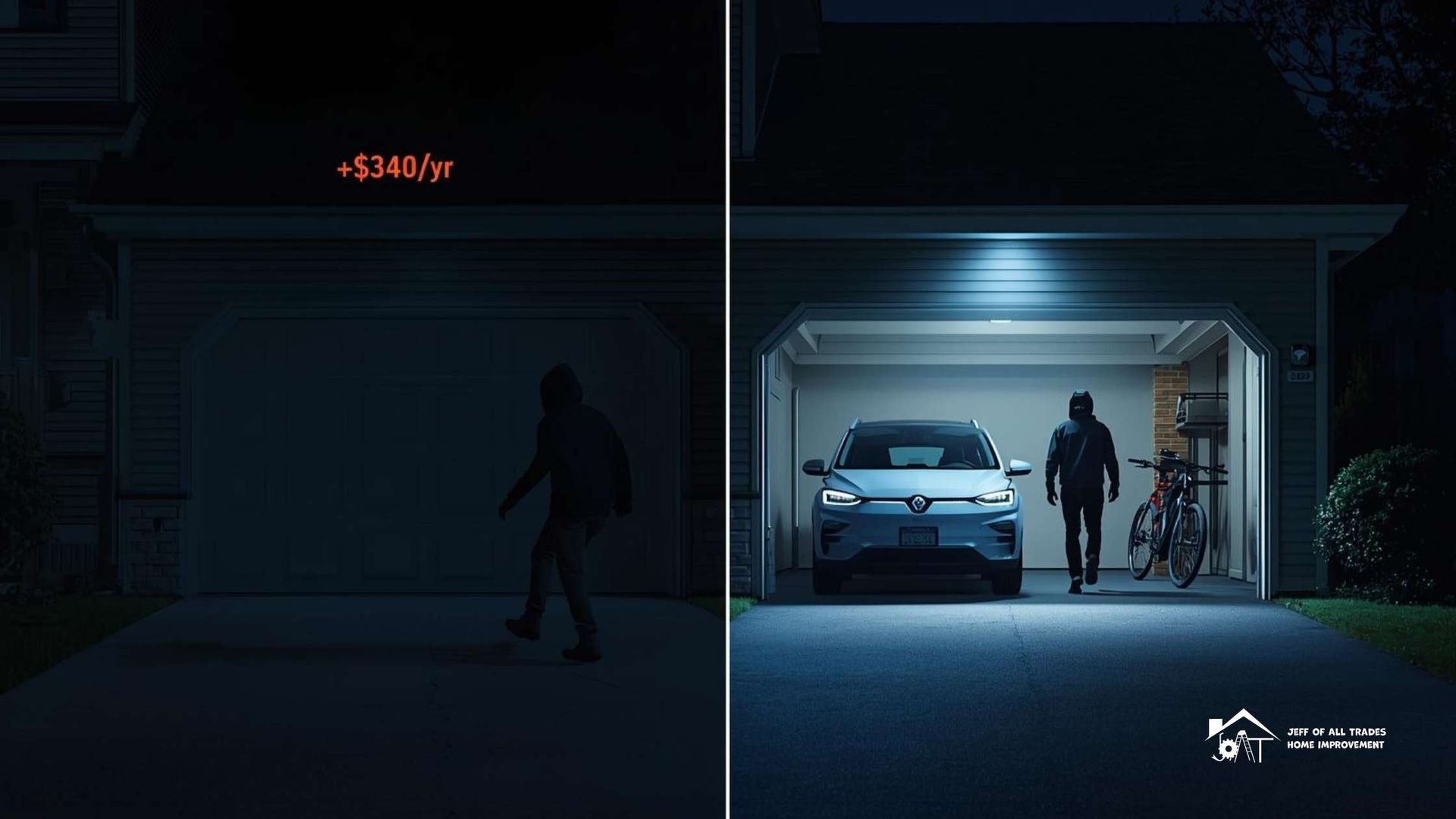
Smart garage lighting is powerful.
It's not just about having fancy tech. It's about real security improvements and actual money savings that show up on your electric bill every single month.
If you're in New Jersey and your garage still has those old fixtures running on timers or—worse—lights you forget to turn off that burn electricity all day, you're wasting money and leaving your home vulnerable.
Let me show you exactly how smart garage lights work, what they cost, how much you'll save, and how to choose the right system for your home.
Why Your Current Garage Lighting Is Costing You Money and Security
Please walk out to your garage and count the light fixtures. Now think about this:
How many hours per day are those lights on?
The Old Garage Lighting Math
Typical old garage setup:
- 4 fluorescent fixtures, 32 watts each = 128 watts total
- Running 8 hours per day (conservative estimate)
- 128 watts × 8 hours = 1,024 watt-hours = 1.024 kWh per day
- 1.024 kWh × 365 days = 373.76 kWh per year
- 373.76 kWh × $0.17 = $63.54 per year
If you're like many people and forget to turn the lights off:
- Running 12 hours per day: $95.31 per year
- Running 16 hours per day: $127.08 per year
- Running 24/7 (some people do this): $190.62 per year
And that's just electricity costs. Old fluorescent bulbs should be replaced every 1-2 years. At $8-15 per bulb × 4-8 bulbs, you're spending another $32-120 on replacements.
The Smart LED Garage Lighting Math
Modern smart LED setup:
- 4 LED fixtures, 18 watts each = 72 watts total (already 44% less power)
- Motion-activated: only when needed
- Average actual use with motion sensor: 45 minutes per day
- 72 watts × 0.75 hours = 54 watt-hours = 0.054 kWh per day
- 0.054 kWh × 365 days = 19.71 kWh per year
- 19.71 kWh × $0.17 = $3.35 per year
Annual savings range from $60.19 to $187.27, depending on your current usage.
Plus: LED bulbs last 15-25 years—zero replacement costs for decades.
Plus: The motion sensor feature means you never walk into a dark garage, and you never leave lights burning when nobody's there.
But the energy savings are honestly the secondary benefit. The real value is security.
How Smart Garage Lights Actually Prevent Break-Ins
Burglars are opportunistic.
They look for easy targets.
A dark garage?
Easy target. A garage that floods with light the second they approach? They move on to the next house.
The Psychology of Motion-Activated Security Lighting
What happens when a burglar approaches:
Without smart lights:
- The dark garage gives them cover
- They can work unnoticed
- Neighbors don't see anything unusual
- They have time to try the door, look for unlocked windows, and check for valuable items visible through windows
With motion-activated smart lights:
- Sudden bright light triggers a startle response
- They're immediately visible to anyone watching
- Creates perception of active monitoring ("They must have cameras if they have motion lights")
- Removes the cover of darkness they rely on
- Most importantly, they immediately leave
Real Data on Security Lighting Effectiveness
The Newark Police Department did a study in 2019-2020 on residential break-ins. They found:
- 83% of burglaries occurred at homes with inadequate exterior lighting
- Homes with motion-activated security lighting were 50% less likely to experience break-in attempts
- When break-ins did occur at well-lit homes, they happened during daytime hours, not at night
Similar data from the University of North Carolina study on burglary deterrence (2025 update) found that 60% of convicted burglars reported they'd immediately avoid a home if motion-sensor lights were activated.
The bottom line: Lighting is one of the most cost-effective security measures you can implement.
The Garage: Your Home's Most Vulnerable Entry Point
Most people focus security on front doors and windows. But your garage is actually the easiest entry point for burglars:
Why garages are targeted:
- Often hidden from street view
- People leave garage doors unlocked
- Garage door openers are often left in cars (easy theft target)
- Garage windows allow viewing of valuable items (bikes, tools, equipment)
- The interior door from the garage to the house is often less secure than the front door
- Once inside the garage, the burglar can work on the interior door without being seen
Smart garage lights address all of these vulnerabilities:
- Motion detection means that any approach is immediately lit
- Well-lit garage removes the ability to hide
- Sudden lighting attracts attention from neighbors
- Many smart systems send notifications to your phone
- Integration with cameras provides visual verification
- Scheduled lighting creates an "occupied" appearance even when you're away
One client in Princeton installed smart garage lighting after someone attempted to open their garage door at night. The motion light scared them off, but the client received a phone notification and called the police with a description and timing. Police caught the suspect two streets over, attempting to enter another garage.
Investment: $640 for a smart lighting system
Value: Prevented burglary, led to arrest, created a safer neighborhood.
Can you put a price on that peace of mind?
Smart Garage Lighting Installation: Step-by-Step Process
Whether you DIY or hire a pro, here's what the process looks like so you know what to expect.
Pre-Installation Planning
Step 1: Assess your current garage lighting
- Count existing fixtures and note their condition
- Measure light output (does the garage feel dark or well-lit?)
- Check your electrical panel—note the breaker serving the garage
- Identify any electrical issues (flickering, buzzing, or old wiring)
Step 2: Determine your needs
- Garage size and layout
- Current light levels (test with phone light meter app)
- Security concerns (approach paths, visibility from street)
- Desired features (voice control, scheduling, notifications)
- Budget
Step 3: Choose your system
- Based on budget, needs, and existing setup
- Decide DIY vs. professional
- Purchase materials or schedule a consultation
Advanced Features: Getting the Most from Your Smart Garage Lights
Scheduling and Automation
Smart lighting schedules we recommend:
Weekday schedule:
- 6:00-8:00 AM: Motion sensor mode (30% brightness baseline, 100% on motion)
- 8:00 AM-5:00 PM: Off (daytime—use natural light from windows)
- 5:00-10:00 PM: Motion sensor mode (full brightness)
- 10:00 PM-6:00 AM: Security mode (20% baseline, 100% on motion for 1 minute)
Weekend schedule:
- More flexible hours based on family routine
- Possibly extended morning mode for garage projects
Vacation mode:
- Random on/off patterns to simulate occupancy
- 7:00 PM-11:00 PM: Turn on for 20-minute intervals at random times
- Coordinated with other home lights for a convincing "lived-in" appearance
Geofencing Automation
Many smart systems support geofencing—lights automatically respond to your phone's location:
Arriving home:
- Garage lights turn on when you're 0.2 miles away
- By the time you pull in, the garage is fully lit
Leaving home:
- When your phone moves 0.5 miles away, all garage lights turn off automatically
- Never waste energy leaving lights on all day
Integration with Other Smart Home Devices
Smart garage lights + smart garage door opener:
- Lights stay on for 5 minutes, then return to motion sensor mode
- Get a notification if the garage door opens and the lights don't turn on (may indicate an electrical problem)
Smart garage lights + security cameras:
- Lights turn on when the camera detects motion
- Better video quality with proper lighting
- Recorded events are clearly visible
- Coordinated notifications (see what triggered the lights)
Smart garage lights + door/window sensors:
- Lights turn on if the interior door from the garage to the house opens (convenient when carrying items)
- Lights flash if the garage door is left open longer than 10 minutes (alert feature)
Smart garage lights + smart thermostat:
- If the garage heater/AC is on, the lights can indicate status (helpful for workshop spaces)
Why Choose Jeff's Home Improvement for Your Smart Garage Lighting
We've been serving New Jersey homeowners covering various service areas for over 20 years. Here's what makes us different:
Licensed and Insured:
All our electricians are licensed in New Jersey, fully insured, and continuously trained on the latest smart home technology.
Transparent Pricing:
Free consultation and written quote with no hidden fees. What we quote is what you pay.
Quality Materials:
We only use professional-grade fixtures from reputable manufacturers with proven track records.
Warranty:
2-year labor warranty, plus manufacturer warranty on all fixtures (typically 5-10 years).
Professional Installation:
Code-compliant installation, proper permitting, and inspection coordination. Your work will pass any home inspection.
Smart Home Expertise:
We don't just install lights—we help you integrate them into your complete smart home ecosystem.
Customer Service:
Rated 4.9 stars on Google with 500+ reviews. We return calls within 24 hours and stand behind our work.
No Pressure:
We'll give you honest recommendations based on your needs and budget. If DIY makes sense for you, we'll let you know.
Take Action Today
Don't wait for a break-in to upgrade your garage security. Don't waste another month on high electric bills from outdated lighting.
Call Jeff's Home Improvement today for a free consultation:
Or visit our website: to:
- Schedule a free garage lighting assessment
- Get instant pricing for common garage sizes
- See our portfolio of completed projects
- Read reviews from your neighbors
Smart garage lighting isn't just an upgrade—it's an investment in your home's security, your family's safety, and your financial future through energy savings.
Let us show you exactly how much you can save and how much safer your home can be.
Jeff's Home Improvement: Lighting the way to safer, smarter homes across New Jersey since 2004.