

The $847 Mistake That Almost Burned Down a House in Morristown. Can Homeowners Do Their Own Electrical Work in NJ
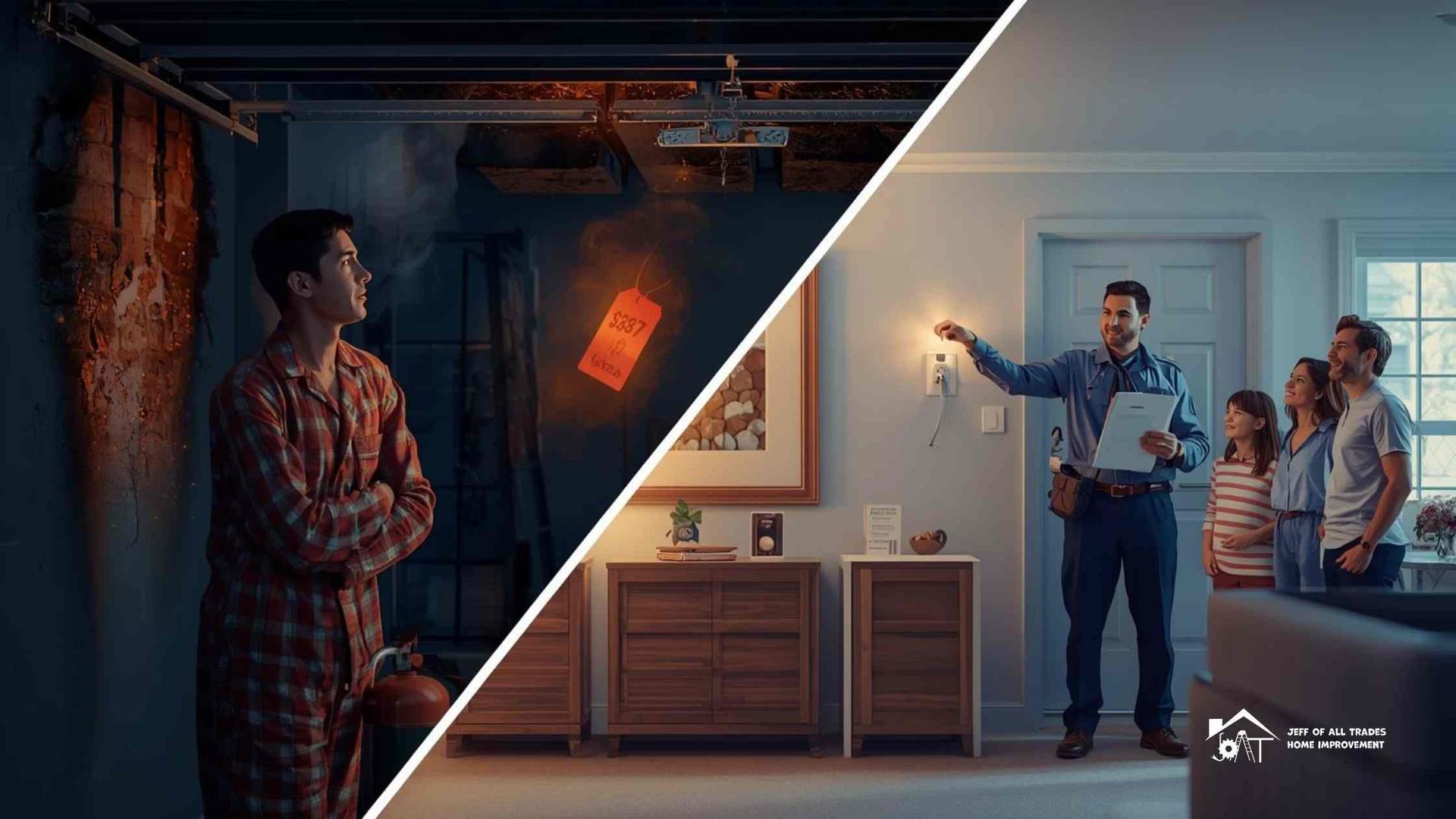
Last month, Mike from Morristown called us at Jeff's Home Improvement in a panic. His homeowners' insurance had just denied a $47,000 claim for fire damage. The reason? Unlicensed electrical work was discovered during the investigation.
Mike had watched some YouTube videos and replaced an old outlet in his garage three years ago. Simple enough, right? Swap the wires, screw it in, done. He'd saved maybe $150 by not calling an electrician.
That outlet eventually overheated due to improper wiring. It caught fire at 2 AM while his family slept. Thankfully, their smoke detectors woke them up, and everyone got out safely. The garage burned, smoke damaged the whole house, and they lost two cars.
Then came the insurance adjuster.
The fire inspector found the outlet wasn't installed to code—wrong wire gauge, loose connections, no proper grounding. When the adjuster asked who did the work, Mike admitted he'd done it himself. No permit. No inspection. No licensed electrician.
Claim denied. $47,000 out of pocket. Home warranty voided. Future insurance problems guaranteed.
All to save $150.
This scenario plays out more often than you'd think in New Jersey. And the answer to "can homeowners do their own electrical work in NJ" isn't as simple as yes or no—it's complicated, and getting it wrong can cost you everything.
New Jersey has some of the strictest electrical codes in the country, and for good reason. This isn't California, where homeowner electrical rights are more lenient. This is New Jersey, where the state takes electrical safety seriously because we live in older homes with aging infrastructure in one of the most densely populated states in America.
This guide will tell you exactly what you can legally do yourself, what requires a licensed electrician, how permits and inspections work, and most importantly—how to avoid the insurance and warranty nightmares that happen when you get it wrong.
Whether you're trying to save money, take pride in DIY work, or just want to replace a light fixture, you need to read this before you touch a single wire in your New Jersey home.
The Legal Reality: What New Jersey Law Actually Says
Let's start with the law, because everything else flows from here.
New Jersey operates under the National Electrical Code (NEC) with state-specific amendments. The state's electrical regulations are enforced by local building departments under the Uniform Construction Code (UCC).
Here's the short version: New Jersey law allows homeowners to perform electrical work on their primary residence under specific conditions, but with significant restrictions that most homeowners don't understand.
What Homeowners CAN Legally Do (With Permits)
According to New Jersey statute N.J.A.C. 5:23-3.4, homeowners may perform electrical work on their owner-occupied, single-family dwelling without hiring a licensed electrician IF:
- You own the property (not renting, not investment property)
- You live there as your primary residence (not vacation home, not rental)
- It's a single-family home (not multi-family, not condo unless rules allow)
- You obtain proper permits (this is non-negotiable)
- The work passes inspection (a licensed electrical inspector must approve it)
- You follow all NEC and state electrical codes (same standards as professionals)
Examples of work homeowners can legally do with permits:
- Replacing outlets and switches
- Installing new light fixtures
- Adding circuits (if you know what you're doing)
- Upgrading outlets to GFCI or AFCI where required
- Installing ceiling fans
- Running new wiring for additions or renovations
- Installing outdoor lighting
The critical detail everyone misses: You still need permits and inspections for almost all of this work. Just because you CAN do it doesn't mean you can skip the official process.
What Homeowners CANNOT Do (Ever)
New Jersey law prohibits homeowners from performing certain electrical work even with permits:
Completely off-limits:
- Service panel replacement or upgrades (must use licensed electrician)
- Work on the utility service connection (only the utility company or a licensed electrician)
- Any commercial electrical work
- Work on properties you don't personally occupy
- Work on rental properties (even if you own them)
- Work on multi-family dwellings beyond your own unit
Practical reality in many NJ municipalities:
Some local building departments are stricter than state law requires and may not issue homeowner permits for any electrical work. Please check with your township or city building department.
For example, some towns in Bergen and Essex Counties require licensed electricians for all electrical work, regardless of homeowners' rights under state law. Local ordinances can be more restrictive than state law.
The "Consequential Damage" Problem
Here's a scenario that actually happened to a family in Princeton Junction:
They replaced their own basement outlets (unpermitted). A year later, a completely unrelated plumbing leak flooded their finished basement—$ 23,000 in damage.
During the insurance investigation, the adjuster noted that the outlets appeared new. When asked, the homeowners admitted to performing DIY electrical work without permits.
The insurance company denied the entire water damage claim, arguing:
- The homeowners violated their policy by doing unpermitted work
- The outlets were installed below the flood line without proper waterproof boxes (code violation)
- This created an additional risk that the policy didn't account for
- Material misrepresentation of the property condition
The homeowners sued. They lost. The court ruled in favor of the insurance company.
Total cost of saving $300 on outlet installation: $23,000 plus legal fees.
Title Insurance and Home Sales
When you sell your home in New Jersey, the title company and buyer's attorney will ask about permits for any renovations or electrical work. If you can't produce permits for work that requires them, you have problems:
Potential consequences:
- Buyer demands a price reduction
- Buyer demands you hire a licensed electrician to inspect and certify all work
- Buyer demands you obtain "after-the-fact" permits (expensive and complicated)
- The sale falls through entirely
- You may need to disclose unpermitted work to future buyers (legal requirement in NJ)
One client came to us after their home sale fell apart when inspection revealed unpermitted electrical work throughout the house. The previous owner had done extensive DIY renovations.
Our fix: $8,700 to bring everything to code, obtain retroactive permits where possible, and get licensed electrician certifications. The sale closed two months late, and our client had to reduce the price by $15,000 to keep the buyer happy.
The Insurance Rate Impact
Even if your insurance doesn't deny a claim, discovering unpermitted electrical work will affect your rates:
- Premium increases of 15-40% after any electrical fire claim
- "High risk" classification that lasts 5-7 years
- Difficulty finding new insurance (claims follow you in the CLUE database)
- Some insurers will non-renew your policy entirely
When is DIY electrical work safe from an insurance perspective? Only when:
- You obtained proper permits
- The work passed inspection
- You have documentation
- The work meets the current NEC code
Anything less is a ticking time bomb.
The Warranty Nightmare: What Happens to Your Home Warranty
If you have a home warranty (and you should), DIY electrical work can void coverage in ways you may not have considered.
New Home Warranties
If you bought a new construction in New Jersey, your home comes with a 10-year New Home Warranty under the New Home Warranty and Builders' Registration Act.
This warranty covers:
- 1 year: artistry and materials
- 2 years: mechanical systems (including electrical)
- 10 years: structural defects
Here's the catch: If you modify the electrical system with DIY work, you can void the warranty on the entire electrical system—even for defects that existed before your work.
The Safety Reality: Why Professional Electrical Work Matters
Let's be honest: Some DIY electrical work turns out fine. Many handy homeowners have successfully replaced outlets and switches without causing a fire.
But here's what I've learned watching people get hurt over two decades at Jeff's Home Improvement:
The problem isn't usually what you know. It's what you don't know you don't know.
The Hidden Dangers in "Simple" Electrical Work
Replacing an outlet seems simple:
- Turn off the breaker
- Remove the old outlet
- Match wire colors
- Install a new outlet
What can go wrong (and does):
- Aluminum wiring: If your home was built between 1965 and 1973, you might have aluminum wiring. It requires special outlets and connection methods—standard copper-rated outlets on aluminum wire cause overheating and fires. You need to identify this before you start.
- Backstabbing: Push-in wire connections (backstabs) are quick but create loose connections over time. They overheat and cause fires. Proper pigtail connections with wire nuts are required by code in many applications.
- Overloaded circuits: You might not realize the circuit is already at capacity. Adding another device could overload it, tripping breakers constantly, or causing overheating.
- Improper grounding: If your home has older two-wire systems without ground, you can't just install three-prong outlets without proper grounding. This is one of the most common DIY mistakes and is extremely dangerous.
- Box fill violations: There are strict limits on how many wires and devices fit in an electrical box. Overstuffing causes overheating. Most DIYers don't even know to check this.
A licensed electrician knows all this instantly. A DIYer watching YouTube might not even be aware of these issues.
The Arc Flash Hazard
Working on live circuits—even if you think the breaker is off—can cause arc flash injuries. This is when electricity jumps through the air, creating a plasma explosion.
Arc flash can:
- Causes severe burns even without direct contact
- Damage eyesight permanently
- Stop your heart
- Ignite clothing
NJ electrical code violations related to lockout/tagout and live work procedures cause several serious injuries in the state each year. Professional electricians are trained in arc flash protection. DIYers rarely even know it's a risk.
The "It Worked for 5 Years" Problem
Here's the insidious thing about electrical mistakes: they might work fine for years before failing catastrophically.
Common delayed-failure scenarios:
Improper wire nut connection: Works fine for 3-7 years, then slowly loosens due to thermal cycling. Eventually, the arc overheats and starts a fire in the wall, where you can't see it until it's too late.
Undersized wire: You are using 14-gauge wire where the code requires 12-gauge. It works fine with normal loads. Then one day, you plug in a space heater, and the wire overheats inside the wall. Fire.
Missing junction box cover: You run wiring and forget to install an access cover on a junction box in the attic. Years later, insulation shifts and contacts the hot wire terminals. Fire.
Water intrusion: You are not properly sealing the outdoor outlet. Rain slowly corrodes the connections over months. Eventually shorts and fails—hopefully by tripping the breaker, but maybe by burning.
A licensed electrician's work is less likely to have these ticking time bombs because they've seen every possible failure mode and know how to prevent them.
The Cost Analysis: When DIY Actually Costs More
Everyone does DIY to save money. But let's run the real numbers for common New Jersey electrical projects.
Scenario 1: Replacing Outlets (Kitchen GFCI Upgrade)
DIY approach:
- 4 GFCI outlets: $120
- Voltage tester: $25
- Wire nuts and supplies: $15
- Homeowner permit fee (if obtained): $75
- Your time: 4-6 hours
- Total: $235 + your time
Risk factors:
- If you don't know that a kitchen requires 20-amp circuits, you might buy the wrong outlets
- If you backstab connections, you may fail in 3-5 years
- If you don't get a permit (many don't), zero resale documentation
- If work causes fire later: $10,000-50,000+ uncovered damage
Professional approach (Jeff's Home Improvement):
- Materials: $140 (we source professional-grade)
- Labor: $380
- Permit fee: $75 (included)
- Licensed electrician installation
- Guaranteed code compliance
- Total: $595
Cost difference: $360
Value of professional work:
- Proper installation guaranteed
- Insurance-valid documentation
- Warranty on labor and materials (1-2 years typically)
- No risk of uncovered fire damage
- Transferable permit documentation for home sale
- Peace of mind
Real cost comparison over 10 years:
- DIY success case: Saves $360
- DIY failure case: Costs $10,000-50,000 in uncovered fire damage
Professional case: Costs $360 more upfront, zero risk of catastrophic loss
Which would you choose?
Scenario 2: Adding Outdoor Lighting
DIY approach:
- Outdoor fixtures: $200
- Wire, conduit, and supplies: $120
- GFCI outlet: $35
- Tools (if you don't own): $80
- Homeowner permit (if obtained): $75
- Your time: 8-12 hours over multiple days
- Total: $510 + your time
Common DIY mistakes we fix:
- Using indoor-rated wire/boxes outdoors (code violation, fails inspection)
- Improper burial depth for underground wiring (code violation, dig hazard)
- No GFCI protection (code violation, electrocution hazard)
- Inadequate waterproofing (early failure)
Professional approach:
- Materials: $360 (professional-grade weatherproof)
- Labor: $780
- Permit and inspection: $95
- Total: $1,235
Cost difference: $725
But here's what happens when DIY outdoor electrical fails:
The client in Cherry Hill did their own outdoor lighting. Buried wire too shallow (code requires 18" minimum in conduit). The landscaper hit the wire two years later. Shocked the landscaper (minor injury, thankfully), damaged equipment, and created liability exposure.
Costs:
- Landscaper medical bills: $2,400 (homeowner's liability)
- Legal consultation: $800
- Emergency repair by licensed electrician: $1,100
- Homeowner's insurance premium increase after liability claim: $200/year for 5 years = $1,000
Total cost of saving $725: $5,300
Scenario 3: Installing Ceiling Fan
DIY approach:
- Ceiling fan: $180
- Fan-rated junction box: $15
- Wiring supplies: $20
- Homeowner permit (rarely obtained for this): $50
- Your time: 2-4 hours
- Total: $265 + your time
Professional approach:
- Materials: $215
- Labor: $320
- Permit included: $65
- Guaranteed proper support
- Total: $600
Cost difference: $335
Why this matters:
Improperly installed ceiling fans fall. A 50-pound fan falling from 8 feet has serious injury potential. It happens every year in New Jersey.
Insurance perspective: If an improperly installed ceiling fan injures someone, your homeowners' liability coverage may deny the claim for improper installation. That's potentially hundreds of thousands in uncovered medical bills and damages.
Is $335 in savings worth that risk?
The Hidden Cost: Your Time Has Value
If you earn $75,000 per year, your time is worth approximately $36 per hour (working hours). If you earn $100,000, your hourly rate is $48.
Kitchen outlet upgrade:
- DIY time: 6 hours = $216-288 of your time
- DIY cost: $235
- True DIY cost: $451-523
- Professional cost: $595
- Professional is actually only $72-144 more expensive when you account for your time
Plus, professional work is:
- Done correctly
- Code compliant
- Insured and warrantied
- Completed in 2-3 hours instead of spreading across your weekend
When does DIY make financial sense?
Only when:
- Your time truly has no value (you enjoy it as a hobby)
- The work is genuinely simple (replacing a single light fixture)
- You have the knowledge and tools already
- You're getting proper permits and doing it to code
- The stakes are low if something goes wrong
For most New Jersey homeowners with full-time jobs and families, hiring a licensed electrician is the financially smart choice once you account for all costs and risks.
The Smart Homeowner's Electrical Strategy
Here's my recommendation after 20 years of seeing what works and what causes problems:
Do These Things Yourself (Low Risk)
With appropriate caution and research:
- Replace light fixtures (like-for-like, no new wiring)
- Change outlet and switch cover plates
- Install smart switches in place of existing switches (if comfortable with wiring)
- Replace existing outlets with the same type (if you know what you're doing)
Always:
- Turn off the breaker and verify power is off with a voltage tester
- Take photos before you start
- Don't attempt if you find anything unexpected
- Call a pro if anything seems wrong
Always Hire a Licensed Electrician For
No exceptions:
- Electrical panel work (replacement, upgrades, repairs)
- Running new circuits
- Any work that modifies your home's electrical capacity
- Outdoor and underground electrical work
- Whole-house rewiring or major renovations
- Aluminum wiring modifications
- Work in wet locations (bathrooms, kitchens, outdoors)
- Adding 240V circuits (dryers, ranges, EV chargers, AC units)
- Troubleshooting persistent electrical problems
- Generator installations
- Any work you're not 100% confident about
The Bottom Line: Your Home, Your Choice, Your Risk
Can homeowners perform electrical work in NJ?
Yes, with significant limitations and proper permits and inspections. But should you? That's a different question.
The legal answer and the smart answer aren't always the same.
You have the legal right to do basic electrical work in your owner-occupied New Jersey home. But you also have the right to:
- Risk voiding your insurance coverage
- Risk voiding your warranties
- Risk of creating fire hazards
- Risk of electrocuting yourself
- Risk expensive code violations at sale time
- Risk of devastating financial liability
I'm not saying you should never do any electrical work yourself. I'm saying, understand the complete picture before you decide.
The $200 you save by replacing an outlet could cost you $47,000, as Mike from Morristown found out. Or it could go fine, and you'll feel accomplished.
The question is: Are you comfortable with that risk?
At Jeff's Home Improvement, we've seen both outcomes hundreds of times. Homeowners who hire licensed electricians sleep better at night. Their insurance covers them. Their homes sell smoothly. They don't worry about fires.
The homeowners who did DIY electrical work without proper permits and procedures? Some are fine. Others are living with financial disasters they'll be paying off for years.
Contact Jeff's Home Improvement today for a free electrical safety consultation. Our licensed New Jersey electricians will assess your home, identify any concerns, and provide you with clear, honest recommendations.
We serve all of New Jersey with licensed, insured, and experienced electrical professionals. Same-day emergency service available.
Don't gamble with your home's electrical system. Trust the professionals who've been keeping New Jersey families safe for over 20 years.