

Floor Tiling Patterns That Minimize Cuts in New Jersey Kitchens
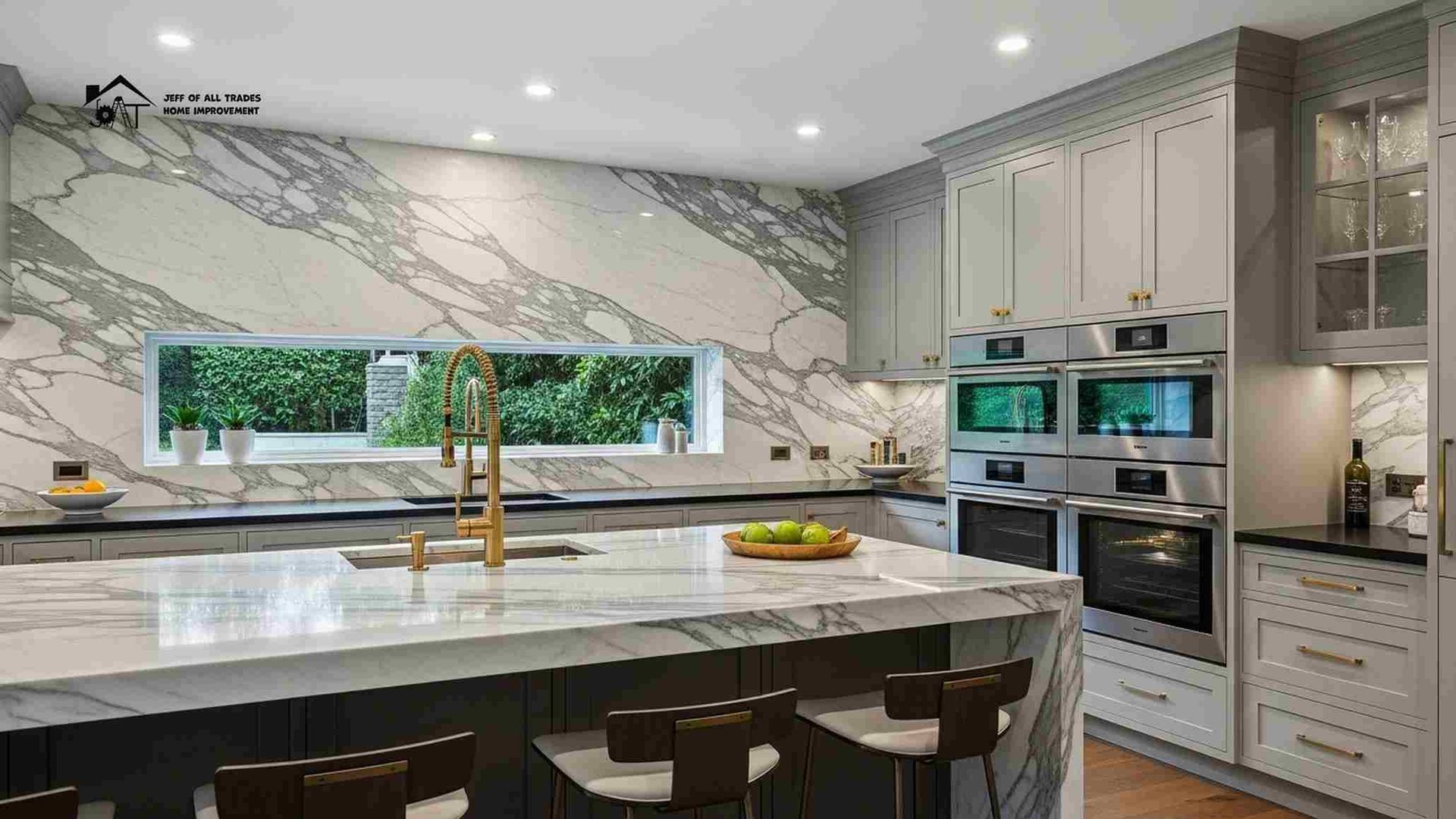
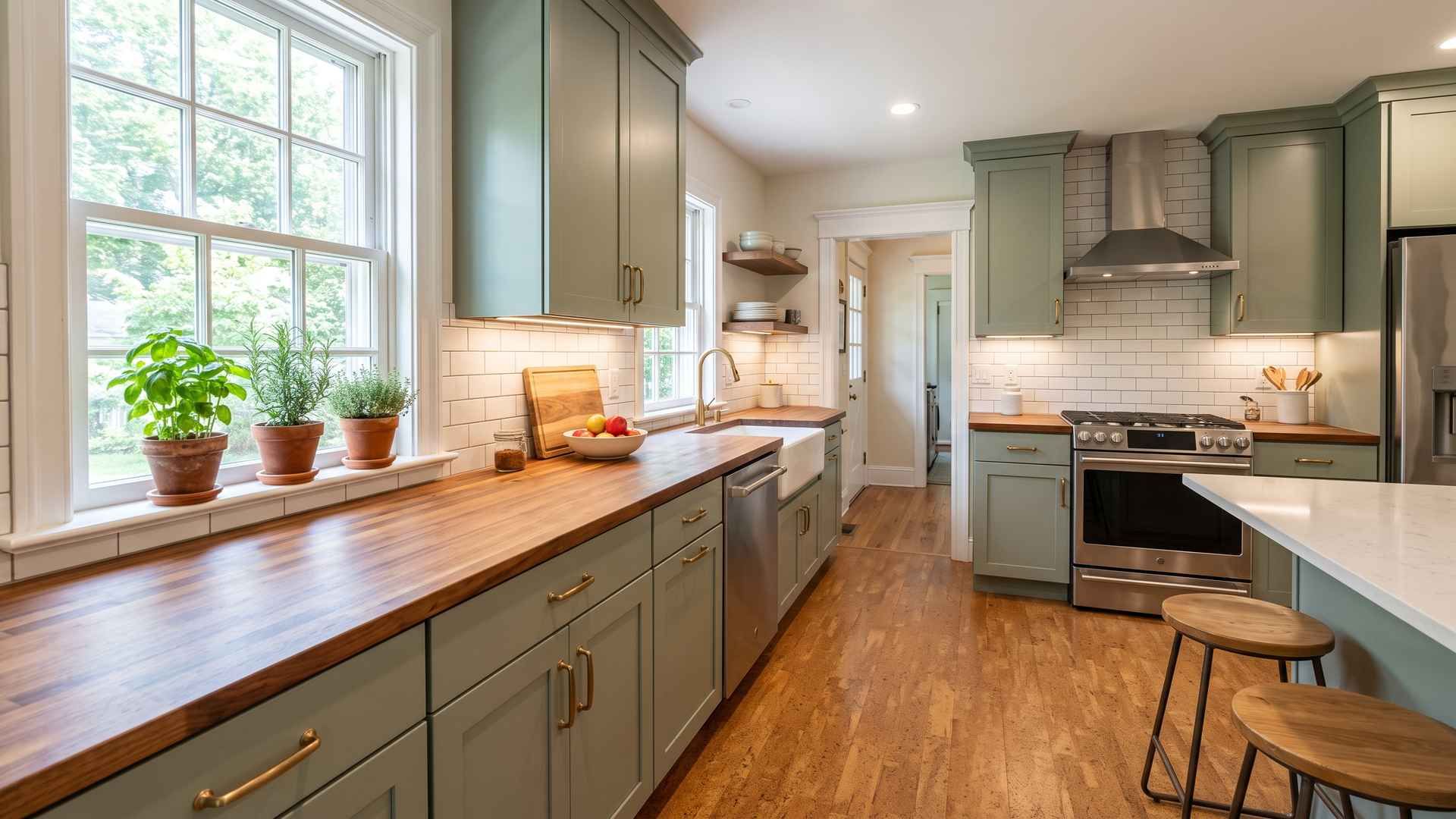
From a tight Hoboken galley kitchen with a non-movable radiator to a sprawling Hunterdon County farmhouse with walls that haven’t been square since the 1800s, New Jersey kitchens have character. That character often means tricky layouts. When it comes to tiling, every corner, cabinet, and appliance creates a challenge. More cuts mean more time, more dust, and more money spent on wasted tile.
But what if you could choose a layout that looks incredible while drastically reducing the number of trips to the wet saw? Smart kitchen floor tile patterns NJ homeowners choose can do just that.
At a Glance: Low-Cut Tile Patterns
| Pattern Name | % Waste / Cuts (Best-Case) | DIY Difficulty | Visual Vibe | Best Tile Sizes |
|---|---|---|---|---|
| Straight Lay | 10% | Easy | Classic, Grid-like | 12″×12″, 18″×18″, 12″×24″ |
| 1/3 Offset Brick | 12% | Easy-Moderate | Modern, Transitional | 12″×24″, 6″×24″, 8″×36″ |
| Modular (e.g., 12-6-6) | 14% | Moderate | Rustic, European | Mixed sizes (often boxed) |
| Large-Format Stack | 10% | Moderate | Minimalist, Contemporary | 24″×24″, 24″×48″ |
| Strategic Diagonal | 18% | Advanced | Dynamic, Space-enlarging | 12″×12″, 18″×18″ |
Deep Dive: Smart Kitchen Floor Tile Patterns NJ
Let's break down how these patterns work and which one is right for your space and budget.
Straight Lay on Centerline: The No-Brainer for Square Rooms
This is the most common and straightforward pattern. Tiles are laid in a simple grid. The key to making it look professional is the starting point. Don't start against a wall! Find the center of the room by snapping two perpendicular chalk lines. Dry-lay a row of tiles along each line to see how your cuts will land at the walls. By adjusting this centerline slightly, you can ensure you have equal, sizable cuts on opposite walls, avoiding tiny, unprofessional-looking slivers. This is the best way to minimize tile cuts in a relatively square room.
- Layout Math: Simple. Your main job is to center the layout.
- Pro Install Cost (NJ): For standard 12x12 or 12x24 tile, expect professional kitchen tile installation labor in NJ to run $8–$14 per square foot.
- DIY Cost: The price of tile plus about $100–$150 for a one-day rental of a wet saw or score-and-snap cutter.
- Appliance Gaps: Always tile underneath your fridge, dishwasher, and stove. It creates a level surface and prevents headaches if you ever change appliance models.
1/3 Offset Brick: Hides Seams, Still Low Waste
You've seen the 1/2 (or 50%) offset brick pattern everywhere. The 1/3 offset is its more sophisticated cousin. Instead of each tile starting at the midpoint of the tile below it, it starts one-third of the way along the tile below it. This staggered look is excellent for long, rectangular tiles (like 12″×24″), as it helps hide minor bowing in the tile and subfloor imperfections. It adds more visual interest than a straight lay without significantly increasing waste. Start your first row with a full tile along the most visible wall, like the one you see from the living room.
- Layout Math: Each new row starts 1/3 of a tile length beyond the previous one. Create a sequence (e.g., Row 1 starts with a full tile, Row 2 with a 2/3 piece, Row 3 with a 1/3 piece, then repeat).
- Pro Install Cost (NJ): Slightly more than a straight lay, around $10–$16 per square foot due to the extra measuring.
- DIY Cost: Same as straight lay, but requires more careful planning and marking.
Modular 12-6-6: Pre-Packed Math That Avoids Slivers
Modular patterns, often called Pinwheel or Versailles patterns, use a mix of tile sizes to create a repeating, interlocking design. A simple version for a kitchen might use 12″×12″ and 6″×6″ tiles. The beauty is that these patterns are designed to fit together perfectly, and many manufacturers provide the layout diagram right on the box. This is a fantastic choice for larger kitchens, like those in many Bernardsville or Warren homes, as it breaks up the monotony of a huge floor without the complexity of a random layout.
- Layout Math: Follow the manufacturer's diagram. The pattern repeats over a certain area (e.g., every 4 square feet).
- Pro Install Cost (NJ): This is more complex work. Expect a Somerset County tile contractor to charge $15–$25 per square foot for labor on a modular pattern.
- DIY Cost: Higher difficulty. You need to be very organized to keep track of the different tile sizes and their placement.
Large-Format Stack: Modern Look, Fewer Joints, Minimal Cuts
For a clean, contemporary look, nothing beats large-format tiles (24″×24″ or bigger) laid in a simple stacked grid. The logic is simple: fewer tiles mean fewer grout lines and fewer tiles to cut overall. This pattern makes small spaces, like kitchens in Bloomfield row-homes, feel larger and more open. The critical factor here is your subfloor. It must be perfectly flat, or you’ll get “lippage,” where one tile edge is higher than its neighbor. A professional will first use a self-leveling compound to prep the floor.
- Layout Math: Same as a straight lay, but with much larger pieces. Centering is crucial.
- Pro Install Cost (NJ): Installing large-format tile is a specialty. Expect labor costs of $18–$30+ per square foot, as the tiles are heavy and require special mortars.
- DIY Cost: Not recommended for beginners due to the subfloor prep and difficulty handling the heavy tiles.
Strategic Diagonal Starter Tiles: When Angles Pay Off
A diagonal layout (tiles set at a 45-degree angle) is typically the highest-waste pattern. However, in an L-shaped or oddly angled kitchen, it can be a secret weapon for minimizing tile cuts. Instead of having a straight grid that results in awkward, tapered cuts where the "L" turns, a diagonal pattern can meet both legs of the "L" with more uniform triangular cuts. The trick is to start your pattern in the inside corner of the L and work outwards. This is an advanced technique that requires careful calculation.
- Layout Math: Complex geometry. You'll be working with 45-degree angles and calculating triangle sizes.
- Pro Install Cost (NJ): This is premium work. Expect labor costs of $16–$28 per square foot.
- DIY Cost: High. This is where most DIYers get into trouble. Best left to a pro.
Measuring & Layout Prep Checklist
- Find and Snap Centerlines: Measure to locate the centers of the two longest opposing walls, then snap a chalk line between them. Do the same for the shorter walls to create a perfect cross in the middle of your room.
- Dry-Lay Test Rows: Without any mortar, lay a full row of tiles with spacers along each chalk line, from the center to the walls.
- Apply the Half-Tile Rule: Look at the gap left in the wall. If it’s less than half a tile’s width, you’ll have a tiny, weak, ugly sliver. To fix this, adjust your starting centerline by half a tile’s width. This shifts the whole layout, giving you a larger, more stable cut at both ends of the room.
- For Out-of-Square Walls: In older NJ homes, forget finding a true center. Identify the longest, most visible wall (e.g., the wall with the main cabinet run). Snap your primary chalk line parallel to that wall. This ensures the grout lines look straight where it matters most. The angled, tapered cuts will be hidden on less conspicuous walls or under appliances.
Waste & Budget Calculator: 180 sq. ft. Kitchen Example
Always order extra tile for cuts and future repairs. Here’s how much extra you’d need for a 180-square-foot kitchen based on the pattern:
- Straight Lay / Large-Format Stack (10% Waste): 180 sq. ft. + 18 sq. ft. = 198 sq. ft. total order
- 1/3 Offset Brick (12% Waste): 180 sq. ft. + 22 sq. ft. = 202 sq. ft. total order
- Modular Pattern (14% Waste): 180 sq. ft. + 26 sq. ft. = 206 sq. ft. total order
- Diagonal Layout (18% Waste): 180 sq. ft. + 33 sq. ft. = 213 sq. ft. total order
Cutting-Time Hacks
- Use a Score-and-Snap: For straight cuts on most porcelain and ceramic tiles under 3/8″ thick, a manual score-and-snap cutter is faster, quieter, and less messy than a wet saw.
- Batch Your Cuts: Mark all identical cuts at once using a piece of painter’s tape as a template on your saw’s fence. Cut them all in one go.
- Hide Cuts Strategically: Plan your layout to place cut tiles under the cabinet toe-kicks, the refrigerator, or along the wall where the pantry is. Full, uncut tiles should be in the main walkways and entrances.
Grout Tips for NJ Kitchens
Your grout has to stand up to tracked-in winter road salt, humidity, and inevitable kitchen spills. Use a high-performance, stain-resistant cementitious grout or, for the ultimate durability, an epoxy grout. While more expensive, epoxy is waterproof and nearly stainproof. If you use standard cement grout, be sure to seal it after it cures and re-seal it annually.
FAQs: Floor Tiling Patterns That Minimize Cuts in New Jersey Kitchens
How do I keep grout lines straight when tiling through a doorway?
Your layout lines must continue uninterrupted. Snap your main chalk line right through the doorway into the next room. You can also use a laser level to project the line perfectly straight from one space to the next, ensuring your grid doesn't drift.
Can I mix 12x24 and 6x24 tiles without creating extra waste?
Yes, this is a great way to create a custom look. A pattern where two 6x24 tiles are laid next to a 12x24 tile (to form a 24x24 square) can be very efficient. The key is that the smaller tiles are exact fractions of the larger ones.
Do radiant-heat mats change my layout math?
No, the layout planning and math are the same. However, you must be extremely careful when spreading the thinset mortar over the heating wires. Use the flat side of the trowel first to embed the wires completely, then comb the notched side over that layer. Never jab the trowel into the floor.
What’s the absolute minimum waste percentage I should order?
Never order less than 10% extra, even for the simplest job in a perfectly square room. One broken box during shipping, one mis-cut, or one cracked tile during installation can bring your entire project to a halt. Having a box left over for future repairs is a lifesaver.
A Pro Tip Before You Start
Thinking about tiling around that kitchen island to save a few bucks? Ask yourself if that island might ever be moved, replaced, or resized in a future remodel. If the answer is even a slight "maybe," you need to tile under it. I’ve been called to fix too many jobs where a homeowner is left with an ugly concrete patch in the middle of their beautiful floor. A true Somerset County tile contractor plans for the future, not just the present.
Ready to Plan Your Perfect Kitchen Floor?
Choosing the right tile pattern is the first step to a beautiful, long-lasting, and cost-effective kitchen floor. If you’re feeling overwhelmed by the math or just want a flawless, professional result, we’re here to help.
With over 20 years of experience in kitchen tile installation in NJ, Jeff Of All Trades Home Improvement can help you select and install the perfect floor for your home and budget.
- Call or Text for a Free, No-Obligation Quote: 908-963-3533
- Email Us Your Questions: jeffofalltradeshandymanservice@gmail.com
- Proudly Serving: Bedminster, Basking Ridge, Bernardsville, Far Hills, Gladstone, Hillsborough, Warren, and surrounding towns.